Evolution is what happens when environmental pressure causes permanent change because that change is suddenly better than continuing on as before.
Biologically, evolution is not a conscious choice and it is not always sudden. But the larger pattern remains: when the environment changes, continuity sometimes depends on becoming different.
Change is an often difficult but necessary thing in order for life to preserve itself. This idea of continuity that life concerns itself with only matters to life itself. Non-living things do not care for continuity, they just are. It does not matter to a rock if an earthquake occurs or if it’s melted. It simply is. But to a living thing, such occurrences are catastrophic because it is unable to survive those events. Therefore, all living things value preserving stasis. Not necessarily stasis in the way that everything remains still, but rather stasis in the way that the kinds of change that threaten the continuation of the daily pattern that is conducive to life continuing.
The base nature of the world is chaos. Collisions. Eruptions. Explosions. Violent events that change whole planets, constellations, and galaxies at a time. But the physical world also contains extraordinary regularity, from gravity to orbital patterns to crystallization, but that order is indifferent to whether any particular organism survives within it. Nature, and in a broader sense chaos, is not hostile to life. It simply does not prioritize life’s continuation. Again, it simply is.
But to life, that chaos can be the end. Life is fragile. Life can exist only within the circumstances it evolved in and only through great effort did it come to be and did it continue. Life is easy to snuff out in the chaos of the world and so life values stasis, peace, and continuity of the same.
From these chaotic events, one word comes to mind: rupture.
Rupture is when something existing in stasis suddenly bursts. The contents kept hidden inside spill out for all to see. Rupture is a physical process but can also be emotional and metaphorical as well. It sounds catastrophic because it is chaotic in nature. A ruptured organ, a ruptured hull, a ruptured cell. These all lead to death.
But rupture is not life, it just is. It is the process of things no longer being able to be contained due to the building of immense pressure until the constraints holding that pressure in simply no longer can. A lesson we learn in early school in science class is that movement will always happen between two spaces of differing volume, pressure, or contents. Water will always flow to where there is none until the water in both spaces is equalized.
The exact physical process differs depending on what is moving, whether it is pressure, fluid, molecules, heat, or concentration. But each contains the same intuitive truth: gradients create movement. Difference creates pressure toward change.
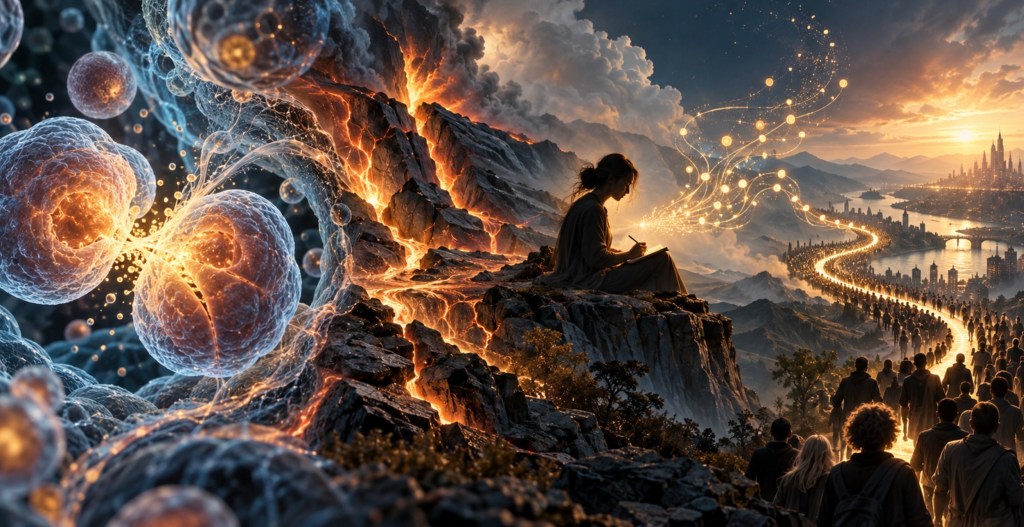
Rupture, as a concept, is also not just the negative connotation of the word. The word itself carries meaning with it that we associate with violence but what if it was an idea shared to masses? A dream held onto so hard and so tightly by someone until the pressure of not living that dream causes it to rupture from their lips to close ears?
And what of that idea then? It takes on its own life from this rupture and continues to spread. Sometimes this small paragraph uttered explodes into the status quo and becomes a movement. This idea is repeated in front of millions of others, some receptive and some not, until entropy takes hold and an evolution occurs. This dream becomes so stressful as it collides against the reality of everyday life until we as a species must evolve to accommodate it.
Entropy, in the strict scientific sense, does not describe this social process. But there is a similar metaphorical pattern here: once an idea escapes containment, it enters a larger system. It collides with other ideas, structures, habits, and people, and those collisions may produce changes that cannot be neatly reversed.
But, of course, this is all metaphorical and is quite a large concept. Let’s go back to the simple and to the physical. Rupture. That’s precisely what happens when a new human comes into the world. The water breaks, an ancient process takes places, and a new human comes into the world. A rupture that is on purpose and well timed but a rupture all the same.
It is this very process, replicated and repeated over and over, that changes the living world to the point of permanency. To evolution.
Birth itself is not evolution, but it is one of the processes that makes evolution possible. Across generations, reproduction carries variation forward, and environmental pressures determine which variations persist. Rupture, then, may not be evolution itself so much as one of the thresholds through which evolution becomes possible.
It is this very process that spurs on the greatest written works of all time. When a world, idea, or message builds inside someone until they must write it down or else risk exploding themselves. The words spill out onto the page, historically black ink on white bleached sheets of tree called paper. An evolution brought by the need for the stasis of information. An invention that brought life.
Here, rupture becomes something slightly different again. It is not merely destruction. It is the failure of a boundary to keep something in its previous state. A private thought becomes language. Language becomes writing. What had existed inside one mind suddenly becomes capable of surviving outside it.
We tend to define life as something breathing and experiencing, but maybe we should define it broader to something that requires stability in order to endure. A story requires less stability than a human and has the potential for a much larger lifespan, but only if the circumstances are right for it to endure.
Some stories begin and end at a campfire while others change forms from oral to written to digital in the modern age, and very well might change forms again as time marches on.
And this may be the real paradox of continuity: sometimes the thing that survives is the thing most willing to change form. An oral story can become ink, ink can become pixels, and the physical vessel may be replaced entirely while something recognizable persists. Survival does not always mean preserving the original form. Sometimes it means preserving the pattern through transformation.
This raises an even stranger question. How much can something change and still remain the same thing? A body replaces its cells. A culture rewrites its customs. A story changes medium. A person can experience something that makes their previous understanding of the world impossible to return to. In each case, continuity survives not because nothing changed, but because something essential endured through the change.
Rupture is not the chaotic and catastrophic thing you believe it to be. Rupture is what is required for the continuation of the story.
Or perhaps more precisely, rupture is what sometimes becomes necessary when the old container can no longer hold what must continue. What looks like destruction from the perspective of the old form may be the beginning of continuity in another.


Leave a Reply